okami.mom/strata
git clone https://git.nkp.pet/okami.mom/strata
a4af4df61
main
files
| README.md | 7.6 KiB |
| overview.png | 213.5 KiB |
| overview.svg | 124.9 KiB |
| plot.py | 3.2 KiB |
| probe.py | 6.1 KiB |
| results.json | 6.0 KiB |


Existing RoPE and YaRN at 512K and 1M
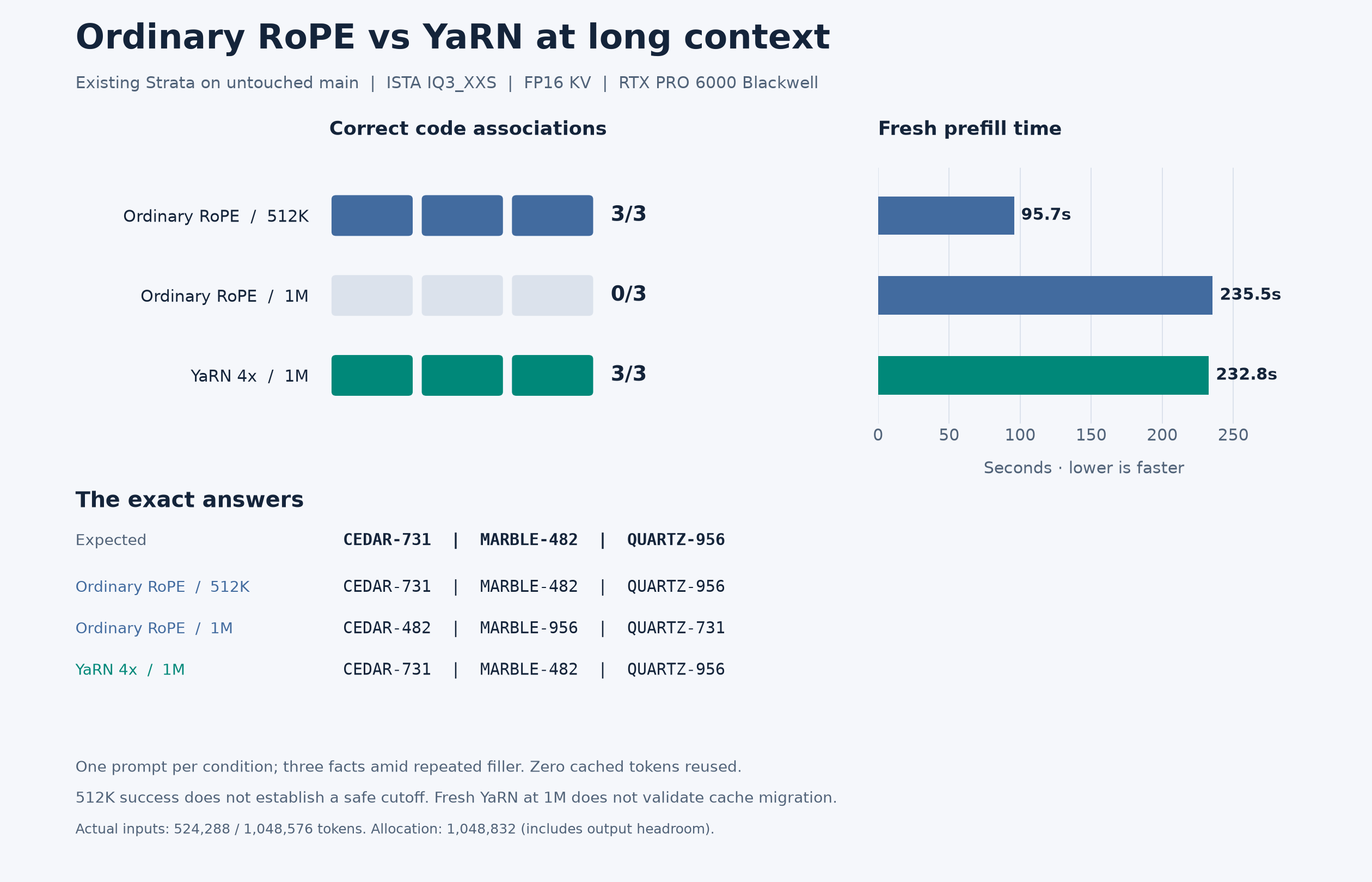
This report uses Strata's existing YaRN implementation on unmodified main. It adds a reproducible probe, per-run measurements, and a figure; no inference code, cache converter, or serving default changes are included.
What this tells us about choosing RoPE settings
- Within this artifact's declared 262,144-token context: retain the normal model/setup defaults. This long-context probe does not establish that enabling YaRN permanently improves short requests.
- Beyond the declared context: Strata setup already selects experimental YaRN and a covering scale. Continue using that documented behavior. Ordinary RoPE's successful 512K probe is not evidence of a safe 512K cutoff.
- At 1M: compare the exact answers below. This is one three-fact retrieval prompt, not a general 1M quality certification or a measurement of where to switch scaling. No automatic quality acceptance threshold is used.
The model's context metadata is an artifact declaration, not independent proof of its training history. YaRN changes positional behavior throughout the conversation, including shorter positions. A process uses one RoPE configuration.
Set up YaRN simply
YaRN is already in main; this PR is not required to enable it. For an existing Strata installation, rerun setup with the desired total context capacity.
Linux:
./setup.sh --setup --context 1048576--rope-scaling yarn--rope-scale 4
Windows:
START- HERE . bat -- setup -- context 1048576 --rope -scaling yarn --rope -scale 4
Stop the current server before rerunning setup. Select the model you want to
configure; --setup saves the new settings and starts it. On later launches,
run ./setup.sh on Linux or START-HERE.bat on Windows to use the saved settings,
then send requests normally. For 512K,
use --context 524288 --rope-scaling yarn --rope-scale 2. That is the existing
setup policy; YaRN 2x at 512K was not measured in this report.
Setup chooses other options for your hardware, so these commands do not promise
the FP16 benchmark's memory use or speed on another GPU. Check the resolved
context and RoPE settings in the startup log.
When launching the native engine directly, add these to your existing model arguments (replace any conflicting context/RoPE flags):
--max-context 1048576--rope-scaling yarn--rope-scale 4--yarn-orig-ctx 262144
The context capacity includes the prompt and generated reply: leave room for output. The benchmark used a slightly larger allocation of 1,048,832 to test an actual 1,048,576-token input plus its reply and engine headroom.
Example request to a local server after setup (change the port/key if configured):
curl http://127.0.0.1:8080/v1/chat/completions \-H 'Content-Type: application/json' \-H "Authorization: Bearer $ STRATA_API_KEY " \-d '{"model":"strata","messages":[{"role":"user","content":"Write a Python function that returns the maximum of a nonempty list."}],"max_tokens":128,"temperature":0,"reasoning_effort":"none"}'
Restart with the selected settings before starting the conversation. Do not restore an ordinary-RoPE KV session into a differently configured YaRN engine. Replay the canonical conversation under YaRN to build matching state. This report does not implement an in-place switch or validate approximate cache migration followed by continuation to 1M.
See Strata's existing context-extension documentation and the earlier 1M YaRN measurement, #348.
Workload and measurement boundaries
The user message contains three codes, separated by repetitions of apple
and orange. The final request is: “Return all three codes in order separated
by |. Nothing else.” The exact tokenizer/template renders the prompt to either
524,288 or 1,048,576 tokens. probe.py constructs those IDs and records
their SHA-256; the two 1M conditions must have identical input hashes.
Expected answer:
CEDAR-731|MARBLE-482|QUARTZ-956
Each condition starts a separate resident engine with no cached-prefix reuse. The timed request starts after model loading. Prefill and decode rates come from the engine's timing line; TTFT and total request time are also retained. The output cap is 64 tokens; report the actual generated count. RAM is the engine's Linux RSS high-water mark (including mapped/shared pages), and VRAM is device-wide usage sampled approximately once per second. These are not allocation-accounting totals. There are no other inference jobs on the GPU.
This is one run per condition, three expected associations, repeated filler, and a short reply. No confidence intervals, percentile latency claims, broad coding-quality claims, or safe switching boundary can be inferred. The names and numbers being present but incorrectly paired is recorded as an association error, not hidden by a substring-presence score.
Reproduce
Use upstream main at fb58e0dbc8399662c0e47c76578c6e878b14f6cf and an existing
ISTA IQ3_XXS configuration. Build on the benchmark GPU:
cmake -S .-B build-DSTRATA_ENABLE_CUDA=ON \-DCMAKE_CUDA_ARCHITECTURES=120 \-DCMAKE_CUDA_COMPILER=/usr/local/cuda/bin/nvcc cmake --build build-j8 --target stratapython bench/results/2026-10-09-rope-yarn-long-context/probe.py \--config strata.json--exe build/strata--tokens 1048576 \--rope yarn--output /tmp/strata-yarn-1m
For the ordinary-RoPE comparison, change only --rope yarn to --rope none
and choose a new output directory. For its 512K condition, also change
--tokens to 524288. These are deliberate native-engine extrapolation probes;
setup itself refuses ordinary RoPE beyond the declared context.
The probe fixes FP16 KV, prefill 8192, MTP off, suffix drafting off, speculation width 2, parked-conversation RAM cache off, CPU prefill share zero, deterministic greedy decoding, and allocation capacity 1,048,832. Model/pack paths and the expert profile come from the supplied configuration. It needs Strata's existing Python environment; no separate evaluation service is used.
Run python plot.py in this directory to regenerate PNG and SVG figures from
results.json (requires matplotlib). Model weights, token caches, private
profiles, and credentials are not included.
Measured results on untouched main
| Configuration | Actual input | Correct pairs | Fresh prefill | Prefill tok/s | Decode tok/s | Generated |
|---|---|---|---|---|---|---|
| Ordinary RoPE | 524,288 | 3/3 | 95.7 s | 5,479.2 | 103.6 | 22 |
| Ordinary RoPE | 1,048,576 | 0/3 | 235.5 s | 4,452.1 | 82.4 | 22 |
| YaRN 4x from token zero | 1,048,576 | 3/3 | 232.8 s | 4,504.8 | 82.7 | 22 |
All runs: RTX PRO 6000 Blackwell 96 GB, Ryzen 9 7950X, 124 GiB usable RAM,
Ubuntu 24.04.5, NVIDIA driver 595.91.07, CUDA 13.2.86, GPU power limit 400 W.
Main commit: fb58e0dbc8399662c0e47c76578c6e878b14f6cf (engine 0.1.41).
The model is ISTA-DASLab IQ3_XXS; its download revision was not recorded.
The expert profile matches upstream data/expert-profile.bin by SHA-256.
Peak sampled GPU usage: 70.8–70.8 GiB; engine RSS high-water mark: 43.3–43.4 GiB.
The two 1M input hashes match. All three use the same executable hash. The 1M ordinary-RoPE answer was:
CEDAR-482|MARBLE-956|QUARTZ-731
The 1M YaRN answer was:
CEDAR-731|MARBLE-482|QUARTZ-956
See results.json for input/executable/profile hashes, launch arguments, per-run TTFT/total time, resource observations, and all actual answers. No private development-build measurements are mixed into this table.